Power & EnergyComparison
Portable Power Station vs. Generator: Which Backup Power Is Right for You?
Portable power stations vs. gas generators compared: indoor safety, runtime, noise, cost, and maintenance, plus how to size backup power in watts and watt-hours.
By Prep & Survive TeamPublished 7 min read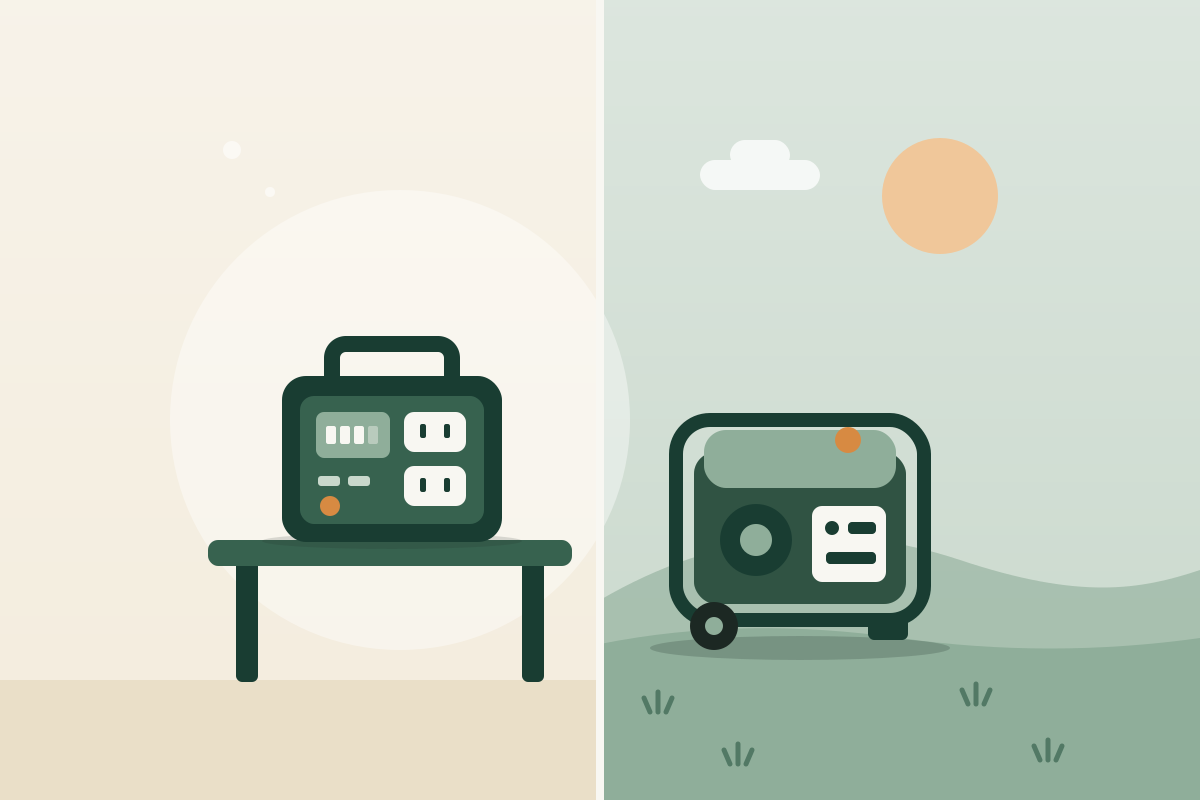
On this page
Key takeaways
- Portable power stations are batteries: they are quiet, produce no fumes, and can be used indoors, but they hold a limited amount of energy.
- Gas generators can run for days with refueling but must be used outdoors only, at least 20 feet from windows, doors, and vents, because of deadly carbon monoxide.
- Size backup power in two numbers: watts for what runs at the same time, and watt-hours for how long it runs.
- Never plug a generator into a wall outlet; use extension cords or a transfer switch installed by a licensed electrician.
- Solar panels can recharge a power station, but real-world output is usually well below the panel's rated watts.
When the power goes out, most households want the same things: keep the phones charged, keep the fridge cold, keep the lights on, and keep any medical equipment running. The two most common ways to do that without a permanent installation are a portable power station (a large rechargeable battery with outlets) and a portable fuel generator.
They solve the problem in very different ways. This guide compares them side by side, shows how to size either one, and covers the safety rules that matter most.
The short answer
- Choose a portable power station if you mainly need to run small electronics, lights, a CPAP, a router, or a refrigerator for part of a day, and you want something quiet that can be used safely indoors.
- Choose a generator if you need to power larger loads, such as a well pump or space heater, or need power for several days with refueling, and you have a safe outdoor spot at least 20 feet from the house.
- Many households use both: a power station for quiet, indoor overnight power and a generator outside during the day for heavier loads and recharging.
Side-by-side comparison
| Factor | Portable power station | Portable gas generator |
|---|---|---|
| Energy source | Built-in rechargeable battery | Gasoline (some models also propane) |
| Indoor use | Yes, no fumes | Never. Outdoors only, at least 20 feet from openings |
| Noise | Nearly silent (fans may run) | Loud; inverter models are quieter |
| Runtime | Limited by battery size; hours to about a day for typical loads | As long as you have fuel and refuel safely |
| Typical output | Lower; suited to electronics and moderate appliances | Higher; can handle heavier loads |
| Recharging or refueling | Wall outlet, car outlet, or solar panels | Requires stored fuel |
| Maintenance | Top up the charge every few months | Oil changes, fresh fuel, regular test runs |
| Approximate cost | Typically $150 to $500 for small units; $500 to $2,000+ for large ones | Typically $400 to $1,200 for conventional; $500 to $2,000+ for inverter models |
Prices are rough US ranges for product categories as of November 2026 and vary widely with capacity and features.
How to size backup power
Every backup power decision comes down to two numbers.
- Watts (W) measure power at a single moment. Add up everything you want to run at the same time. Your power station or generator's continuous rating must be higher than that total.
- Watt-hours (Wh) measure energy over time. A 100-watt device running for 10 hours uses 1,000 Wh. A power station's capacity is listed in watt-hours.
Motors and compressors, such as those in refrigerators and well pumps, briefly draw several times their running watts when they start. This is called surge or starting watts. Check that your power source's surge rating can handle the largest starting load.
Where to find the numbers
- Device labels and manuals list watts or amps. If only amps are shown, multiply amps by 120 to estimate watts.
- Refrigerators have a yellow EnergyGuide label showing estimated kilowatt-hours per year. Divide by 365 to get a daily estimate, then multiply by 1,000 to convert to watt-hours.
- A plug-in electricity usage meter (typically $20 to $40 as of November 2026) measures real consumption and is the most accurate option.
A worked example
Here is one household's 24-hour essentials list. The numbers are illustrative; check your own devices.
| Device | Watts | Hours per day | Watt-hours per day |
|---|---|---|---|
| Refrigerator (EnergyGuide label: 500 kWh/year) | Varies as it cycles | 24 | About 1,370 |
| CPAP without heated humidifier | 40 | 8 | 320 |
| Wi-Fi router | 10 | 12 | 120 |
| Two LED lamps | 10 each | 5 | 100 |
| Charging two phones, twice each | About 15 Wh per charge | n/a | 60 |
| Total | About 1,970 |
Two adjustments turn that into a shopping target:
- Add about 15 to 20 percent for conversion losses. Power stations lose some energy turning battery power into household AC power. That brings the need to about 2,300 to 2,400 Wh.
- Check the surge rating. If the refrigerator runs at about 150 watts but needs several times that for a moment at startup, the power station must handle that peak along with everything else running.
In this example, a station of roughly 2,500 Wh would cover one day. To go longer, you would need a larger battery, a way to recharge it, or a generator. Dropping the refrigerator from the list cuts the daily need to around 600 Wh, which a mid-size station can handle.
For a generator, the math is simpler: add the running watts of everything you plan to run at once, then add the starting watts of the single largest motor. Choose a generator rated above that number.
Generator safety: the rules that matter
Portable generators are a common source of carbon monoxide poisoning after storms and during power outages. CO is colorless and odorless, and it can kill people who are asleep before they notice any symptoms.
Some newer portable generators include an automatic shutoff that stops the engine if carbon monoxide builds up nearby. It is a worthwhile feature, but it does not replace safe placement and CO alarms inside the home.
Power station safety and care
Power stations avoid the fumes, but they are still large batteries.
- Charge and store them away from heat sources, direct sun, and water.
- Use the cables and chargers recommended by the manufacturer.
- Stop using a unit that is swollen, damaged, or overheating.
- Check the charge every few months and top it up so it is ready when you need it. Many manufacturers recommend storing at a partial charge; follow your unit's manual.
Solar recharging: what to expect
"Solar generator" usually means a power station paired with portable solar panels. Solar can keep a power station going during a long outage, but expectations matter.
A panel's rated watts reflect ideal lab conditions. In practice, output depends on sun angle, clouds, heat, shading, season, and how well the panel is aimed. A rough planning estimate:
Panel rated watts × peak sun hours × about 0.75 = watt-hours per day
For example, a 200-watt panel with 5 peak sun hours might deliver around 750 Wh on a clear day, and far less on a cloudy winter day. That is enough to recharge phones, lights, and a CPAP, but usually not enough to run a refrigerator continuously on its own.
Peak sun hours vary a lot by region and season. Plan around a cloudy day, not a perfect one.
Maintenance at a glance
Backup power maintenance
0 of 7
Your next step
Before you buy anything, make a short list of the devices you truly need during an outage and look up their watts. That list will tell you whether a power station, a generator, or both makes sense for your home.
- Plan the rest of your outage response with the power outage preparedness checklist.
- Cut your power needs with efficient light from our emergency lighting guide.
- See where backup power fits in an overall plan with how to start preparing.
Frequently asked questions
Can you use a portable power station indoors?
Yes. Battery power stations do not burn fuel, so they produce no carbon monoxide and are generally safe to use indoors. Follow the manufacturer's guidance on ventilation, charging, and keeping the unit away from heat and water.
How far should a generator be from the house?
The CDC says to operate generators outdoors more than 20 feet from windows, doors, and vents, and Ready.gov adds attached garages. Never run one inside a home, garage, basement, or crawl space, even with doors and windows open.
Can a portable power station run a refrigerator?
Often yes, if its continuous and surge watt ratings exceed what the refrigerator needs. A typical refrigerator may use well over 1,000 watt-hours per day, so a large-capacity station or solar recharging is needed to keep one running for a full day.
Is it safe to plug a generator into a wall outlet?
No. This is called backfeeding and can electrocute utility workers and neighbors or start a fire. Use heavy-duty extension cords to the appliances, or have a licensed electrician install a transfer switch.
Corrections
- : Updated the rain guidance to the CPSC's advice: follow the manufacturer's instructions, which may allow an NFPA-rated generator tent or say to wait. Clarified which agency says what about generator distance.
Sources
- Winter Storms Aren't Over: CPSC Warns of Deadly Carbon Monoxide Risks and Fires During Power Outages — U.S. Consumer Product Safety Commission
- Power Outages — Ready.gov
- Carbon Monoxide Poisoning Basics — Centers for Disease Control and Prevention
The Prep & Survive team researches, writes, and fact-checks every guide against current guidance from FEMA, Ready.gov, the CDC, the American Red Cross, and USDA food safety experts. We update articles when official recommendations change.
How we research and fact-checkGet one practical preparedness step every other week
Join The Ready Brief for checklists, seasonal reminders, and honest gear advice.